Monday, March 24, 2014

Tuggeranong Community Heatlh Centre

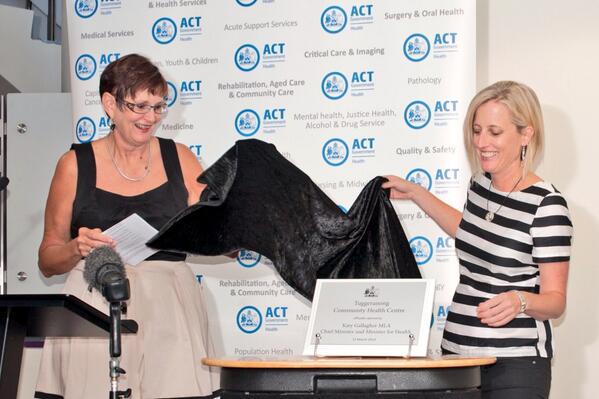
We attended the official launch of the Tuggeranong Community Health Centre on Saturday 22 March 2014. This is the new, refurbished health centre in the Tuggeranong Town Centre.
Dr Peggy Brown and Chief Minister, Katy Gallagher MLA unveiling the plaque (@ACTHealth Twitter feed).

The Community Open Day provided an opportunity for members of the community to walk through the new facility.

We had a stall on the second floor in the new area for renal dialysis. We spoke to consumers about after hours primary care, the role of the walk in Centre as well as how to access services available at the Community Health Centre.
Eleanor and Yelin on the HCCA stand.
The works have been completed as part of the ACT Government's expansion and refurbishment of health services. More information about their health infrastructure program is on the ACT Health website.

Friday, February 7, 2014

Speech at the ACT Health Consumer Representatives Thank You Celebration

I’d like to acknowledge the Ngnunnawal people on whose land we are meeting today and pay my respects to their elders past and present
I’m really pleased to be here today as HCCA President on this important occasion where consumer and carer representatives are recognised and acknowledged for their significant contribution to the ongoing quality and safety of health services in the ACT. Most are volunteers who bring a great deal of  experiential knowledge about their own and their families’ engagement with, and care in, a broad range of services from community based care, to primary and acute care settings. They contribute to all the other expert knowledge around the many tables where decision making processes about health services policy, planning and implementation are undertaken.
The range of representational activity contributed by consumer representatives is impressive indeed. From a HCCA perspective, this year we provided and supported more than fifty active representatives who worked with over 120 committees.
The ongoing commitment of the ACT Government to the implementation of the National Safety and Quality Health Service Standards is providing enhanced opportunities for consumers to continue to work closely with the ACT Health Directorate in improving the quality, safety and effectiveness of healthcare in the ACT. Health services are now required to be more focused on the needs and experiences of consumers and their families in achieving good health outcomes and patient centred health care more broadly. 
This is very much in line with a key principle of the Australian Commission on Safety and Quality in Healthcare which states that:
Patient or consumer centred care is increasingly being recognised as a dimension of high quality health care in its own right, and there is strong evidence that a patient centred focus can lead to improvements in health care quality and outcomes by increasing safety, cost effectiveness and patient, family and staff satisfaction. (http://www.safetyandquality.gov.au/our-work/patient-and-consumer-centred-care/)
The HCCA is committed to responsive, informed and accountable consumer engagement and participation across the health system,
So with our shared knowledge and experience it is important that as consumers we continue to work together to ensure that genuine, effective consumer participation is part of a consumer centred health care system. Successful consumer representation benefits us all including the ACT Government and the ACT community.
We look forward to another busy and productive year ahead.

Sue Andrews

20 November 2013

Thursday, February 6, 2014

The Australian Medicare Local Alliance - National Primary Health Care Conference

National Primary Health Care Conference
Gold Coast Convention and Exhibition Centre, November 13-15, 2013

This conference was attended by over 1400 delegates from around the country and it’s overarching theme was “Keeping People Well and Out of Hospital.”
As well as a national convention for Medicare Locals there were a number of pre conference workshops in the key areas of the ML population health focus such as Indigenous Health, a Mental Health Stakeholder forum, Coordinated Care for Veterans, Nursing in General Practice and eHealth.
The main conference, chaired by Norman Swan (ABC Health Report) featured three plenary sessions with keynote speakers:
·         Mike Farrar, CBE, CEO National Health Service Confederation (UK) spoke about the global challenges of improving primary health care and making it a priority of health spending, reorientating spending from acute to primary care. He also advocated for improving connections with patients in their own care, the sharing of power, recognition of the capabilities of individuals and families.
·         Ron Calvert, CEO Gold Coast Hospital and Health Service,( also from the NHS in the UK) spoke about his experiences of turning around a small hospital in Trafford with the involvement of local GPs. His challenge was how to involve the local user community in the redevelopment of the service.
·         Michael Georgeff, CEO Precedence Health Care and Professor in the Faculty of Medicine, Nursing and Health Sciences at Monash University, discussed the challenges of maintaining the momentum of the eHealth initiative, begun in 2008. He noted that it hasn’t had the expected impact and a focus on process suggested that for eHealth to have good outcomes there needs to be a focus on process rather than data, maximised connectivity and open systems, digital roadways, management of complexity with bottom up innovation and design of the market to drive innovation.
·         Joanne Shaw, Chair of NHS Direct, which provides remote and health advice and information services via phone, web and mobile channels, to patients and the public in the UK.


During a panel discussion about what the  future holds for  GP practice,  Professor Clare Jackson (ML and College of GPs) talked about the emerging primary health care environment as one of uncertainty about funding models, higher accountability, practice based data sharing, higher performance scrutiny, workforce reform, and challenges of managing clinical complexity.

The conference sessions were divided into three themes, run as concurrent sessions:
·         Healthy Communities
·         Connecting Care
·         Fostering Capacity

There were a range of presentations under each theme highlighting the diversity of interdisciplinary  project work being done under the rubric of the Medicare Locals.

Presentations of particular interest (given limits to attending several concurrent sessions!):
·         Identifying local community health needs to enhance population health planning. Hunter ML.
·         The Chronic Disease Pathways Project, Inner East Melbourne ML
·         Transitions of Care between Acute care and Primary care, Paresh Dawda, APHCRI
·         Connecting Care Across Aged Care Services, a gap analysis in Western Sydney ML area.
·         Asylum Seeker Health, SE Melbourne ML with Monash Asylum Seeker and Refugee Health Clinic and Red Cross.
·         Aboriginal men and racism in health services.

The focus of the majority of the presentations was on improving the connectedness and integration of primary health care services to achieve better health outcomes for specific populations at the local level. It was disappointing that the consumer/patient experience and knowledge was often not taken into account as a contributing factor in achieving these outcomes.
For more information about the conference go to their website:


Sue Andrews
Monday, January 13, 2014

Evidence base for needle and syringe program at the Alexander Maconochie Centre


Last week John Didlick, Executive Officer of Hepatitis ACT shared a series of links to articles and an interview on the evidence base for needle and syringe program at the Alexander Maconochie Centre. The evidence is compelling.
  

There is a 10 minute 2CC interview with David McDonald (ANU Fellow and Director of Social Research and Evaluation).

Mr McDonald presents an evidence-based assessment of the merits of a regulated prison-based needle and syringe exchange program at the Alexander Maconochie Centre. Key points include:
·      Safety for prison staff, prisoners, and their families is a key consideration. 
 ·    A strong evidence base demonstrates that regulated prison-based needle and syringe exchange programs make prisons safer.
·      The benefits of regulated prison NSP outweigh any negative consequences.
·      Regulated prison NSPs:
o   reduce transmission of Blood Borne Viruses (BBVs)
o   reduce overdose deaths
o   help create better relationships between staff and detainees
o   lead to an increase in assessment and treatment of drug related problems, and
o   are not associated with increased drug use or drug supply.
·     Needle stick injuries are a key concern for staff currently. Regulated NSPs reduce that danger and have been associated with zero incidents of regulated equipment being used as a weapon.
·     In existing programs overseas, prison staff are supportive of regulated NSPs after initial hesitance and concerns.

A Canberra Times article  flagged the frustrations of public health advocates and the CPSU at apparent slow progress.

Another Canberra Times article  highlighted an increase in contraband (including drugs and drug  paraphernalia), potentially associated with a surge in detainee numbers.

John says:

Until a much needed NSP and tattooing program are realities at the AMC, a larger population and the associated interdiction challenges increase the need for interventions that can prevent and reduce the transmission of blood borne viruses. These must also include consistent, appropriate and discreet access to full-strength household bleach.

Thursday, January 9, 2014

Position Vacant: Policy Officer

Position Vacant:
Policy Officer (SCHADS Level 6)

The Health Care Consumers’ Association (HCCA) is seeking a highly motivated and organised individual to join us as our Policy Officer.

Do you have a positive attitude and like to work in a small and energetic team? Are you a creative thinker and have an understanding of politics and the public policy process? Are you keen to work with consumers to bring about systemic change and improve the quality and safety of health services? Do you want to make a difference to the Canberra community?


We are looking for someone who can work with consumers and community groups to further consumer involvement in decisions regarding the quality and safety of health services. You will need to have experience in policy development and advocacy and have excellent communication and interpersonal skills.

This is a full time position but there is potential to negotiate on hours. HCCA promotes a healthy work-life balance and is committed to offering employees a supportive family friendly working environment. This is a contract until 30 June 2016, in line with our Service Funding Agreement with the ACT Government. Other conditions of employment will be based on the Social, Community, Home Care and Disability Services Industry Award 2010 (SCHADS).

All applications must include:
1. A covering letter stating your intention to apply for the position and addressing the selection criteria listed below.
2. A current CV.
3. Information for two Referees. (Name, Title and Organisation, Relationship to applicant, contact telephone, contact email address)

Applications close at 2pm on Monday 3 February 2014. They can be submitted in hard copy or via email. They need to be addressed to:
Darlene Cox, Executive Director, 

100 Maitland St, Hackett ACT 2602

Selection Criteria are online on seek.com.au:
http://www.seek.com.au/job/25804935