Showing posts with label community care. Show all posts

Monday, May 9, 2016

Report from a Consumer Rep - Online feedback for users, carers and providers

Below is a report by Consumer Representative Bernard Borg-Caruana on a recent session he attended on online feedback for users, carers and providers.

Online feedback for users, carers and providers

This session provided the challenges of gathering and publishing online feedback and recommended ways of increasing the potential of this avenue for users, carers and providers.

Lisa Trigg of the London School of Economics and Political Science presented on online rating and reviews for care providers.

This is in relation to the MyAgedCare website. The presentation for Aged Care  is where the Australian Government is implementing it. However in the UK it applies to all facilities and similar principles apply.

Aged Care covers:  community care, residential aged care and high care facilities.

How can you measure quality and the consumer experience?

Presentation

1. Why is it important?
2. Policy Context
3. Example
4. Challenges
5. Opportunities

Why is it Important?

Online reviews are the new word of mouth that 54% of adult consumers use before making purchases. 

Twitter and opinions empower patients.

We want consumer directed care and empowered consumers

Gravity of the decision

Difficulty of moving between providers

Experience

You can only really assess the service once you have experienced it 

We trust providers.

UK bodies:  CMA + Care Quality Commission (CQC) +  NHS Choices all have a strong interest in this

After engaging constructively with the Competition and Markets Authority (CMA), 2 websites for finding tradespeople, Checkatrade and Trustatrader, and the care home review sites Carehome.co.uk, Care Opinion and Most Recommended Care, have all agreed to improve their practices. These improvements address concerns that were raised following a call for information by the CMA on online reviews and endorsements.

Reviews

The example is often given of Trip Advisor but some excellent lessons from Amazon (particularly regarding Fake Reviews).

Trip Advisor is usually ignored until you’re travelling somewhere where you have no experience: you have to use it.

People go out to dinner and do not review their experience but when selecting a restaurant will look at the star rating.

Some characteristics of aged care settings are “inelastic”:

1. Once you pick a facility you are unlikely to change it; even with bad experiences, a change in care, especially for dementia patients, can be detrimental but social dislocation is a factor for all residents. It is not the same as switching to a new product.

2. The gravity of the decision: How do you know that your loved one would have lived longer or had a happier life at another facility.  This is challenging in retrospect but even more challenging in Prospective decision making.

3. This is not like a diagnosis. You cannot get a second opinion. All care is individual. How can you be sure you have the right care.  

4. Cost of moving—recovering deposits

5. Choice is limited: Availability of services and proximity to the support network.

Residential Aged Care turnover is low and if there is no vacancy. It is unlikely that a consumer will check it out. Could end up with skewed reviews.

Who reviews?

Digital Inclusion reports in Australia and UK equivalent (OFCOM 2013): 

Older people are less likely to be on the internet entering reviews. They spend less time on the internet and few push information 

In Australia less than 10% of Indigenous Aboriginal's have IT access outside cities.

Wisdom of crowds – Surowiecki, 2004

Motivations: Some are altruistic and want to help others make better decisions but others think they can help the providers improve service

How do you know you’re getting a trusted reviewer? Some sites publish a number of reviews performed by a reviewer --- may not be useful in aged care as turnover is low.

Fake reviews— are big business – Amazon is suing publishers and providers of fake reviews.

Fake reviews by providers are a big issue and difficult to manage.

Positive reviews of their business and negative reviews for competitors—See Amazon’s experience

One review in the UK described a facility as excellent; 4 reviews over 3 years said 2 average and 2 terrible; NHS assessment, many areas were average and many below par and is always bordering on being closed down.

Accountability

Laws --- ACCC in Australia – false and misleading claims--  

You can also be held responsible for posts or public comments made by others on your social media pages which are false or likely to mislead or deceive consumers.

Businesses using social media channels like Facebook, Twitter and YouTube have a responsibility to ensure content on their pages is accurate, irrespective of who put it there.

Monitor your social media pages 

Barriers

Access to technology

Sufficient knowledge – technical knowledge to assess all aspects of the facility

Some large organisations may get good average reviews but may have a terrible eg chemotherapy unit ie not all services are the same.

Sometimes the people in the home are not in a position to advise you if they are getting the right care eg dementia patients.

Fear of reprisal and retribution – if you see bruising on your parent in a home ---

For effective review system:  the Government MUST look at defamation laws.

What consumers want:

1. Peer discussion; to meet privately with 1-2 people who had experience with a facility.

2. Stories override rating systems. If someone tells you a story, it often trumps the raw statistics and will sway you.

3. Accountability and reliable reviews

4. Reviews are not a substitute for an effective complaints system and need to be kept separate.

5. Advice to consumers:    Never rely on one source.

Difference in UK

Rating is linked to Pricing:  ie if you have 4+ star rating you can charge above $230 but if you have 3 stars you can charge a max of $230,  etc…

References

Digital Inclusion reports in Australia 

UK equivalent (OFCOM 2013: 

Wisdom of crowds – Surowiecki, 2004

Motivation of Reviewers – Sundaram et al 1998

Ubel 2001

Recognition of Reviewers

CMA report 2016 (Competition and Marketing Authority )

https://www.gov.uk/government/news/online-review-sites-commit-to-improve-practices

https://www.gov.uk/government/speeches/alex-chisholm-on-the-role-of-consumer-enforcers-in-a-changing-environment

By Bernard Borg-Caruana

Monday, March 24, 2014

Tuggeranong Community Heatlh Centre

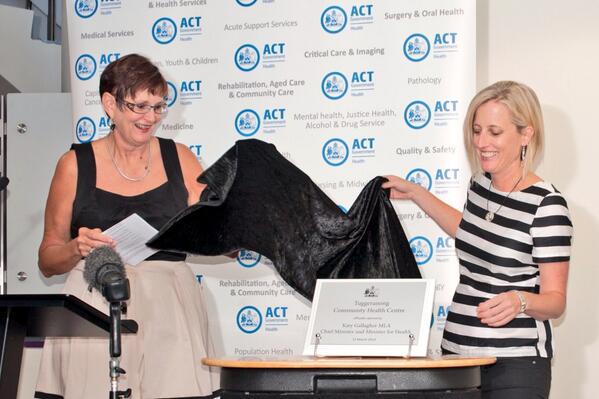
We attended the official launch of the Tuggeranong Community Health Centre on Saturday 22 March 2014. This is the new, refurbished health centre in the Tuggeranong Town Centre.
Dr Peggy Brown and Chief Minister, Katy Gallagher MLA unveiling the plaque (@ACTHealth Twitter feed).

The Community Open Day provided an opportunity for members of the community to walk through the new facility.

We had a stall on the second floor in the new area for renal dialysis. We spoke to consumers about after hours primary care, the role of the walk in Centre as well as how to access services available at the Community Health Centre.
Eleanor and Yelin on the HCCA stand.
The works have been completed as part of the ACT Government's expansion and refurbishment of health services. More information about their health infrastructure program is on the ACT Health website.

Friday, April 3, 2009

Response to Walk-in Centres Discussion Paper Feedback Report

The Minister for Health, Katy Gallagher, this week released the Feedback Report from the community consultation process. The Walk in Centres - Discussion Paper Feedback Report (02 April, 2009) (PDF File - 516k) is available online.

The HCCA Submission in response to the discussion paper is available online. We also posted to the HCCA blog on this.

HCCA strongly supports additional community based primary health care – the Walk-in Centres have the potential to be a valuable complement to existing services.

The ACT Health Feedback Report has reported on both the possible benefits and concerns that submissions expressed. A number of the concerns relate to the lack of specificity in the possible models of care and locations. This was certainly a concern we expressed in our submission. We would like to see a number of issues addressed early in the development of the walk-in centre concept including:
  • Will there be out of pockets costs for consumers in accessing the service?
  • Will the centres have an on-going treatment role?
  • If not, what range of services will be provided and how will this be determined?
  • And what processes will be in place to ensure consumers experience a seamless transition between services such as GPs, ED and community based services?

HCCA believes that while the feedback indicates overwhelming support for the concept of the centres, the next stage should be the identification and development of walk in clinics with models of care and services that are appropriate to the communities to be served.

The consultation process on the centres so far has been encouraging. There remains, however, considerable work to put the concept into effect. Consultation is a critical element in the planning of such community facilities. HCCA urges the Government to continue close consultation with the community, consumers and health care providers in the further development and implementation of the centres.

The offer of partnerships from a number of organisations is a positive sign that provides a basis for the Government to move forward.

HCCA sees the need for extensive monitoring of the effect of walk-in centres on those issues that concerned respondents, such as the impact on the existing health workforce and community pharmacies and GP practices. The monitoring should also provide the basis for a proper evaluation of the introduction of walk-in centres. We would also like to see evaluation on the appropriateness and effectiveness of the care provided to consumers.

HCCA would like to see the services provided to be tailored to the needs of the community at the specific location. The workforce options of multidisciplinary teams, nurse-led or GP practice teams need to be explored in relation in individual walk-in centres so that the service model meets the needs of the community.

The Minister’s response to the Feedback Report is generally positive although we would have liked to see stronger commitment to further consultation with consumers in establishing the models of care and to evaluation of the walk-in centres.

HCCA looks forward to further involvement with the Government in the development and implementation of walk-in centres.

Monday, October 13, 2008

Health Reform discussion papers

The process of developing appropriate reforms of our health system continues. The complex interrelationships of health care, funding, health workforce, commonwealth/states issues just to mention a few major considerations makes untangling and reconstructing our current health system a difficult and complicated task. To assist in preparing a long term health reform plan the National Health and Hospitals Reform Commission (NHRC) invited discussion papers in the key areas of Primary and Community Care, Prevention, Governance, and Public-Private Mix. These papers are now available on the NHHRC website under 'Discussion Papers' at www.nhhrc.org.au

The papers are:

· Achieving a patient-centred, effective, efficient, robust and sustainable primary and community care sector 2020, Professor Claire Jackson and Adjunct Associate Professor Diana O'Halloran
· New Models of Primary and Community Care to meet the challenges of chronic disease prevention and management
, Mark Harris, Michael Kidd, and Teri Snowdon
· Primary Care Reform Options, Hal Swerissen
· New Models of Primary Care and Community Care with a Focus on Rural and Remote Care, Associate Professor Isabelle Ellis, Ms Debra Jones, Professor Sandra Dunn, and Dr Alison Murray
· Models of primary and community care in 2020, Dr Beres Wenck and Ian Watts
· Primary health care in rural and remote Australia: achieving equity of access and outcomes through national reform, Professor John Humphreys and Professor John Wakerman
· New and emerging nurse-led models of primary health care, Professor Mary Chiarella
· Options for reform of Commonwealth and State governance responsibilities for the Australian health system, Professor Judith Dwyer and Professor Kathy Eager
· A Mixed Public-Private System for 2020, Mary Foley
· Funding Policy Options for Preventative Health Care within Australian Primary Health Care, Professor Doris Young and Professor Jane Gunn
· A vision for primary care: Funding and other System Factors for optimising the primary care contribution to the community's Health, Professor Leonie Segal
· A Preventative Priorities Advisory Committee and Prevention Benefits Schedule for Australia, Associate Professor Anthony Harris
· Financial incentives, personal responsibility and prevention, Professor Anthony Scott

A number of these relatively short discussion papers are worth reading by Canberra health consumers as they provide views and some indication of possible policy directions in areas of interest.


Tony