Showing posts with label walk-in centres. Show all posts

Monday, March 24, 2014

Tuggeranong Community Heatlh Centre

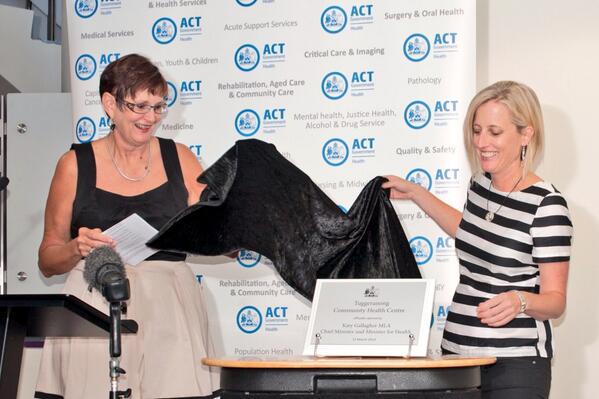
We attended the official launch of the Tuggeranong Community Health Centre on Saturday 22 March 2014. This is the new, refurbished health centre in the Tuggeranong Town Centre.
Dr Peggy Brown and Chief Minister, Katy Gallagher MLA unveiling the plaque (@ACTHealth Twitter feed).

The Community Open Day provided an opportunity for members of the community to walk through the new facility.

We had a stall on the second floor in the new area for renal dialysis. We spoke to consumers about after hours primary care, the role of the walk in Centre as well as how to access services available at the Community Health Centre.
Eleanor and Yelin on the HCCA stand.
The works have been completed as part of the ACT Government's expansion and refurbishment of health services. More information about their health infrastructure program is on the ACT Health website.

Thursday, August 18, 2011

Independent Evaluation of the Nurse-led ACT Health Walk-in Centre

HCCA welcomes the release of the independent evaluation of the Walk In Centre by the ACT Government today.  The evalution was completed by the compiled by representatives of the Australian Primary Health Care Research Institute and The Australian National University

HCCA has consistently supported the concept of Walk-in Centres which involve the development of a community based primary care level that is complements the options already provided by general practice and the hospital emergency departments.  We believe the walk-in centre provides an additional community health care service that will improve health outcomes for the ACT community.

The report contains valuable consumer feedback and analysis of interviews with key stakeholders.  On the whole, feedback is positive, with over 80% of patients surveyed saying they would use the Walk-in Centre again and would recommend it to family and friends. Consumers are pleased to have a service that is community-based and safe.

ACT Govt is today engaging in a 6-week public consultation period on the report and we will be discussing the report with our members and encouraging their feedback, which we will incorporate in HCCA’s response.

Success of this centre supports proposals to create other walk-in centres in the City, Tuggeranong and Gunghalin.  This is an exciting opportunity to provide a range of options for consumers who require care for minor illnesses and injuries.

We look forward to further discussions with ACT Government in the development of these centres.

Darlene Cox
Executive Director

Monday, June 6, 2011

ACT Walk-in Centre

The Walk in Centre celebrated its first anniversary a few weeks ago.

13,420 people have presented to the Walk-in Centre over the last 12 months, seeing on average 40 patients per day and over 250 a week. Of this, nurses at the clinic have treated around 10,000 people.

There has been media around the perception that the walk in centre has increased the presentations to the Emergency Department at The Canberra Hospital.  Of this the  Minister said:
Around 20 per cent are referred to general practice, and the numbers referred to the emergency department are changing as the walk-in centre develops and matures. It has been hanging around six to seven per cent. I understand in the last few months it has been about 3½ per cent.

HCCA spoke to the ABC about this issue recently.  There are details on the ABC website including an interview Darlene Cox did with ABC Canberra presenter, Alex Sloane.

There was discussion in Budget estimates in May about the cost per patient.  The Minister responded:
The advice I have is at the end of March the average cost was around $120 per patient. Obviously, as they are seeing more patients, their costs are coming down. In comparison, the cost of treatment of someone in the emergency department is in the order of $400. I think it is a useful measure to have a look at cost, but if we provided that as the only way of working out whether anything is a success, we would not do a lot things in the health system, I can tell you.

The Hansard for Budget Estimates for 18 May 2011 is available on line as a pdf.

HCCA is very supportive of extending the walk in Centre model to the Community Health Centres in town centres. This is an aspiration of the Government.  The Government is building capacity for walk-in centres in the Belconnen, Tuggeranong and Gungahlin Community Health Centres.

Wednesday, July 22, 2009

Melton Health


Staff from HCCA were very impressed following a tour of the Melton Health Centre on the north west fringe of Melbourne last Wednesday (15 July). Melton Health is one of the sites of Djerriwarrh Health Services.


Melton Health represents a new benchmark for Integrated Primary Health Centres that are proposed in the ACT and also provides excellent ideas for consumer-centred design and refurbishment of Village Creek Centre for the Aged Care and Rehabilitation Services (Read FAQ online 55kb Pdf).

Melton Health is a SuperClinic and was established 3 years ago. Melton Health offers an extensive range of same day medical services, specialist clinics, pathology and radiology services to cater for the health and well being of a rapidly expanding community. It provides around 50,000 occasions of service per year and has greater capacity to provide up to 90,000 service provisions in the future. The figures have shown growth each year but whilst there has been an 8% growth in population, there has been a far greater growth is users of the Centre.

Services were decided on by using population, Emergency Dept, and Health Dept statistics. The highest demand services were chosen and other services were not provided if there was not a critical mass to support them. A Community Advisory Group provided input into what services were provided and the structure of these services. Community consultations were held. The Community was also involved in creating artworks for the Centre, including a large mural at the entrance.

The Centre provides a vast array of services within the one highly functional and attractive environment.

The services provided include:

Urgent Care, Renal Dialysis, Oncology, Haematology, Gastroenterology, Chronic Disease Management, Day Rehabilitation, Orthopaedic Clinic, Endocrinology and Diabetes Clinic, Chest Pain Clinic, Respiratory Clinic, Nephrology Clinic, Dermatology Program, Stomal Therapy, antenatal clinic and classes, Infant Settling and Feeding Clinic, Paediatric Clinic, and an Audiology Clinic.

The centre is open from 9am – 10.30 pm, 7 days a week. Most services are by referral, a few are self- referral.

Particularly noticeable was the absence of consumers waiting to be seen which according to the Executive Officer, David Grace, is due in part to the innovative electronic queueing system by Q-matic. The system allows nine out of ten consumers to be seen straight away by a Clinician, who is prompted upon their arrival by the system. They kiosk can scan the bar code on the consumer’s referral letter which then notifies the clinician that that consumer has arrived. David Grace believed that at first they had underestimated just how effective the queueing system would be. We think this has great potential in assisting consumers in our ongoing quest to tell our stories once and get to the right place and will be raising this for consideration in the Capital Asset Development Program and design and refurbishment of Village Creek.

The Urgent Care Stream is a walk- in service with no appointment required. It’s provided on a non on-going, one off basis where consumers are referred back to their GP for further treatment when required. Interestingly, the local area is similar to the ACT, in that there is a shortage of GP’s. Typically, consumers wait 3- 4 days to see their GP. Since the opening of the Melton Health Clinic, there has been a statistically significant reduction in Emergency Department presentations. The Urgent Care service is both Nurse Practitioner and GP led, with lots of part- time staff working side by side. Discharge summaries are provided in a written format whilst all other medical records are electronic. They are working toward discharge summaries being electronic but at present encrypting taking too long. David reported that they would have two or three code blue emergencies a month and 20% of patients referred to hospital go by ambulance.

The Ambulatory Care Stream is similar to an outpatient clinic except with a Multidisciplinary approach. At a planned appointment, consumers can get back to back appointments with a number of staff. Some staff work across the multidisciplinary team whilst others are part of a specific team. Most doctors are contracted but some are salaried or casual. 5% of doctors rent a room and have their own practice. Recruitment of staff had not been a problem as many professionals wanted to be part of the new and effective system.


The Reception area used glass surfaces and fixtures so as consumers could see the activity going on beyond the waiting area. Each module was secure with Clinicians using swipe cards to let consumers in and out. The secure doors are glass and add to the sense that you are in a welcoming environment rather than an institution.


Electronic records were kept using an electronic system which allowed for both handwritten and computer generated documents to be captured. Eyesoft is the electronic patient master system that sits above all others across the Djerriwarrh community to allow all clinicians to access all records. David Grace mentioned that no consumers have had an issue with privacy and confidentiality of records and so far all have consented to electronic records.

Some other features were pathology, ultrasound and x-ray, and dermatology facilities on site. Group meeting rooms were also provided for educational purposes. The paediatric consultation rooms were of a generous size to allow for the whole family to fit comfortably including an activity table for children.

We were very impressed with building and the sense of being built around consumer needs and also taking into account the needs of staff. HCCA would like to thank David Grace for his time in showing us the Melton Health facility.
Friday, April 3, 2009

Response to Walk-in Centres Discussion Paper Feedback Report

The Minister for Health, Katy Gallagher, this week released the Feedback Report from the community consultation process. The Walk in Centres - Discussion Paper Feedback Report (02 April, 2009) (PDF File - 516k) is available online.

The HCCA Submission in response to the discussion paper is available online. We also posted to the HCCA blog on this.

HCCA strongly supports additional community based primary health care – the Walk-in Centres have the potential to be a valuable complement to existing services.

The ACT Health Feedback Report has reported on both the possible benefits and concerns that submissions expressed. A number of the concerns relate to the lack of specificity in the possible models of care and locations. This was certainly a concern we expressed in our submission. We would like to see a number of issues addressed early in the development of the walk-in centre concept including:
  • Will there be out of pockets costs for consumers in accessing the service?
  • Will the centres have an on-going treatment role?
  • If not, what range of services will be provided and how will this be determined?
  • And what processes will be in place to ensure consumers experience a seamless transition between services such as GPs, ED and community based services?

HCCA believes that while the feedback indicates overwhelming support for the concept of the centres, the next stage should be the identification and development of walk in clinics with models of care and services that are appropriate to the communities to be served.

The consultation process on the centres so far has been encouraging. There remains, however, considerable work to put the concept into effect. Consultation is a critical element in the planning of such community facilities. HCCA urges the Government to continue close consultation with the community, consumers and health care providers in the further development and implementation of the centres.

The offer of partnerships from a number of organisations is a positive sign that provides a basis for the Government to move forward.

HCCA sees the need for extensive monitoring of the effect of walk-in centres on those issues that concerned respondents, such as the impact on the existing health workforce and community pharmacies and GP practices. The monitoring should also provide the basis for a proper evaluation of the introduction of walk-in centres. We would also like to see evaluation on the appropriateness and effectiveness of the care provided to consumers.

HCCA would like to see the services provided to be tailored to the needs of the community at the specific location. The workforce options of multidisciplinary teams, nurse-led or GP practice teams need to be explored in relation in individual walk-in centres so that the service model meets the needs of the community.

The Minister’s response to the Feedback Report is generally positive although we would have liked to see stronger commitment to further consultation with consumers in establishing the models of care and to evaluation of the walk-in centres.

HCCA looks forward to further involvement with the Government in the development and implementation of walk-in centres.

Wednesday, December 17, 2008

ACT Walk-in Centres

ACT Health made a presentation to a group of HCCA consumer representatives on the ACT Health Walk-in Centre initiative on Monday 15 December.

The concept of a walk-in centre in ACT has not been fully developed and consumer input is being sought. ACT Health is seeking public comment on Walk-in Centres in the ACT a discussion paper, by 28 February 2009. The Discussion Paper is available at www.health.act.gov.au.
What is a walk-in centre? This question was asked a number of times on Monday. The answers given were not entirely satisfactory. A team from ACT Health went to the UK to look at a number of the National Health Service models. The ACT centres are likely to have a number of the features that the UK models have. The term walk-in means that consumers walk in off the street, ie there is no need for an appointment.

Features of the UK centres include: the centres are often nurse-led services; they sit between a hospital emergency department and a GP surgery, the types of cases treated will be those that are acute or have minor acuity, for example centres don’t handle breast lumps, rectal exams, childhood vaccinations or provide medical certificates. The centres are not designed to provide ongoing care but operate 365 days a year, 8am to 9pm iare the most common opening hours, busiest times are 12-2 lunchtime and 4-6pm after work. As the centres are part of the NHS they are free, including any GP consultation.

The UK staffing model varies some involving GP’s, many being led by a nurse practitioner or advanced practice nurse – the staffing structure for the ACT has not yet been determined.

It is yet to be decided what aspects of the NHS centres will be incorporated in the ACT centred. The differences in the UK and ACT/Australian health systems, such as the salaried vs. private practice role of GPs, will also impact on the centres services. Allied health and other services to be provided in the ACT such as diagnostic services is also a matter for consideration.
The desirability of including both oncology and mental health services was raised.

It was considered that evaluation should be built in to the development of the centres and this should be done at the beginning.

Members views on the role and services of walk-in centres would be very welcome to inform the HCCA submission to ACT Health in late February 2009.


Tony and Kerry