Wednesday, April 23, 2014

Health Pathways for the ACT


On Monday 7 April I attended a joint workshop with ACT Health an ACT Medicare Local on Health Pathways. Eleanor Kerdo and Katrina, a consumer representative with HCCA, also participated.

Leanne Wells (CEO, ACT Medicare Local) formally opened the workshop and provided a brief  introduction of healthpathways, stating that it is an important collaboration between ACT Health and ACTML. Health pathways is a powerful platform to improve services and outcomes for consumers and they see it as an opportunity to develop pathways that put the patient at the centre of care and aspects of the system that need to be improved and enhanced. 

Rosemary O’Donnell (Executive Director Division of Medicine, ACT Health)  reflected on initial introduction to healthpathways as an exciting opportunity. She sees that this is a framework to enhance the patient journey through the system so that it is as seamless as possible. Rosemary commented that there is a large volume of medical services, including people living with chronic disease, and see that there are opportunities for improvement.

Ian Anderson – Streamliners NZ – Canterbury Health System, was the facilitator for the day. 

The idea of HealthPathways grew out of necessity in Christchurch, NZ. Christchurch is similar to Canberra: urban population of 400,000 people, one major tertiary hospital, catchment of 500,000.
In 2006 the Canterbury District Health Board introduced a new approach to working on problems. This involved new language and terminology, and collaborative approach across the system. By 2010 the new approach was starting to reveal results and improvements which resulted in better outcomes for patients. In 2011 Hunter New England asked about their work and they adopted aspects of their ways of working. They have shared their experience with other Australian districts. There are now 12 entities (Medicare Locals and & Local Hospital Networks) in Australia using elements of Health Pathways and six entities in NZ. In total about 10 million patients across Australia and NZ are part of this.


Three main themes:
  • The environment and creating fertile ground for collaboration and service improvement
  • The detail of service improvement, running work groups and getting change
  • The pathways: these are enablers of service change. They reduce variation in the system and improve outcomes
Ultimately this is all about improving services. In order to achieve sustainable change you need all three of these elements. Thee Canterbury story is a classic demonstration of what is possible when managers have a vision and trust clinicians to be involved in bringing about change.

There was a presentation from Carolyn Gullery, the General Manager of Planning and Funding for Canterbury health system, who was one of the prime drivers of change. This was the presentation she made at the ACI in 2013. (20 min video). It is not online but there is a long video (over an hour) online.

Gullery describes the burning platform, with 1 in 5 people over the age of 65, and by 2020 this will grow to be 1 in 3. There is growing demand, with increased admissions to hospital and increased waiting times. If there was not change there would be a need for many more GPs, another tertiary hospital, another 6000 people in the workforce, and another 2000 nursing home beds. Obviously unachievable and not sustainable.

Graphic of Canterbury health system: Connected system, shared vision. One of the elements that appeals to me is that the work was based on a premise that you shouldn’t be in a hospital if you don’t need to be there. A key measure is not to waste people’s time, both patients and clinical staff. At the core of their work is the belief that most people do the right thing if the system enables them.

A collaborative way of working and it was led by clinicians. They had to bring about a big change. They could not wait for incremental change. 

The full story of the transformation as well as the journey they took is available online on the Kings Fund website.

Executive Director

Friday, April 4, 2014

ACT Dental Health Forum 28 March 2014

On the 28th of March HCCA hosted a Dental Health Forum.
Yelin , Loretta Bettiens and the DHP team
This was presented by Loretta Betteins, Director Dental Health Programs (DHP) and her team.
 Loretta, provided an overview of the public dental program which involves at combination of dentists, dental therapists, prothetists and technicians who make dentures. More recently this expanded to include the oral health and hygienist role. The DHP is a very busy service, taking 4000 phone calls per week making this one of the busiest phone lines in the ACT Government.
Since the last dental forum held 3 years ago, staff numbers have increased from around 90 to 120 people, allowing the DHP to address previously long waiting times and unmet needs of the ACT community.

Darlene and Khalia, getting excited about oral health.

The DHP now operates from 5 community health centres across Canberra.
·         6 Chairs in Gungahlin
·         10 Chairs in Civic

Who can use the services?
·         Child and Youth dental service – all children under 14 in school in the ACT
·         Young people 14 – 18 need a Centrelink card or heath care card
·         Adults who have a  Centrelink card concession or health care card
There is no waiting time for children who need general treatment. Adults who require general treatment, place their name on a waiting list at a community health centre and will be seen within 3-6 months.


Emergency needs

Emergency Services are available for all adults and children out of The Canberra Hospital, People can present to the emergency department after hours, were they are triaged, if deemed to be a high priority i.e facial swelling, infection or trauma to face and mouth they will be seen within 24 hours.  The DHP are looking to increase this capacity of this service through the Emergency Department.

Where are other DHP services delivered?
·         Alexander Maconochie Centre 
      Limited nursing home clinics
·         Some small community groups
·         General anaesthetic work at The Canberra Hospital
·         Calvary Hospital
·         John James Hospital,
·         CC Cares in Stirling
The DHP acknowledged that access to appropriate dental care to people who do not have concession cards but do not have much expendable income is an issue, currently being investigated by the National Oral Health Group. The DHP is also not able to do in-home visits yet and is expanding its reach in nursing homes and residential care communities through the development of the mobile dental clinic.

External funding sources
·         Health Workforce Australia received 500K in 2012 to support dental students. Previously ACT Health did not have a relationship with dental students. Recently the DHP developed a relationship with University of Adelaide dental program, these students do graduate years with the ACT and the program has been very positive with many students returning to work within the DHP in Canberra.
·         The DHP have recently purchased an OPG (Orthopantomogram) machine which is set up Civic. The machine provides a 3D panoramic view of the mouth, teeth and bones of the upper and lower jaws and is similar to a CT Scan in the image that can be created.
·         Federal Budget announcement 2012-3 National Partnership Agreement (NPA) 1 January 2013 over three years.
·         National Oral Health Promotion Plan is being developed – to fund health promotion activities.
·         Child Dental Benefit Schedule voucher system as of 1 January. If a child is receiving Family Tax Benefit Part A or a range of other income support payments they are eligible for this. Private dentist are also participating in this program.

Our wonderful forum participants
What does this mean for the ACT?
From January 2013 the ACT will receive a total of $5.5 million dollars over three years under the NPA plan to reduce public dental waiting lists. At the end of Feb 2014 the ACT has met all the targets set out in the agreement.

Waiting Time
Actual waiting time is currently 2.93 months, compared to February last year where it was 8.49 months. During this time the DHP have removed 2985 clients from the list, and have more than doubled the amount of people they currently see.  Denture waiting list has also seen significant improvements. Wait time is currently 3.06 months compared to 13 months in February of last year.
This data comes from an electronic database, all waiting times are on this database and this is audited annually. Time shown reflects the time from putting your name on the waiting list to when you are sitting in the dental chair.
DHP acknowledges that communication with a transient population like Canberra is difficult and hopes that when The Titanium system will link with ACTPAS and they will be able to update data and improve communication.


Improvements on the way!
·         DHP are looking to improve their informed consent processes. DHP says the electronic client record helps with this and that consent changes being made are consistent with the overarching consent policy from the Canberra Hospital. Using an electronic checklist that the clinician fills in also encourages communication with the consumer to insure they understand, before signing consent forms.
·         DHP have introduced technology that tracks a sterilisation pack of instruments to a particular client to insure safety and quality.
·         DHP have introduced intra-oral cameras that can show clients what teeth are affected, level of decay and conditions on a screen above chair. These images can then be saved on the system.

Mobile Dental Clinic
In the last budget (June 2013) the ACT Government committed 1.6m over 4 years to establish and operate a mobile dental clinic.  This includes $600 thousand to buy the mobile clinic and $250 thousand to run it with a (dentist and dental therapist).
DHP are in the process of developing a model of care for this, involving input from HCCA . Their main focus is providing this service to those living in residential care programs within the ACT, before expanding their scope. They are aiming to see all residents in a two year rolling program.

Partnering with Consumers and Health Literacy
At the forum there were many discussions around the importance of communication with consumers and the development of written materials. DHP was also keen to develop and improve partnerships with consumers about delivery management and policy around these services. HCCA is looking to convene a consumer group about the use of the DHP and is currently in the process of beginning involvement in the development of the mobile dental clinic.
HCCA thanks everyone who attended and Loretta and her team for coming to discuss their program and future consumer involvement.

Eleanor Kerdo
Policy Officer


Monday, March 24, 2014

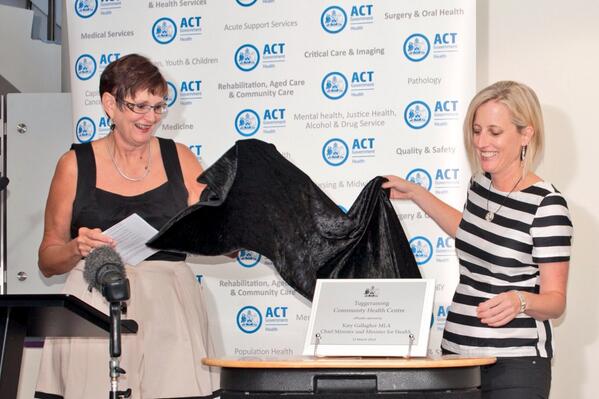
Tuggeranong Community Heatlh Centre

We attended the official launch of the Tuggeranong Community Health Centre on Saturday 22 March 2014. This is the new, refurbished health centre in the Tuggeranong Town Centre.
Dr Peggy Brown and Chief Minister, Katy Gallagher MLA unveiling the plaque (@ACTHealth Twitter feed).

The Community Open Day provided an opportunity for members of the community to walk through the new facility.

We had a stall on the second floor in the new area for renal dialysis. We spoke to consumers about after hours primary care, the role of the walk in Centre as well as how to access services available at the Community Health Centre.
Eleanor and Yelin on the HCCA stand.
The works have been completed as part of the ACT Government's expansion and refurbishment of health services. More information about their health infrastructure program is on the ACT Health website.

Friday, February 7, 2014

Speech at the ACT Health Consumer Representatives Thank You Celebration

I’d like to acknowledge the Ngnunnawal people on whose land we are meeting today and pay my respects to their elders past and present
I’m really pleased to be here today as HCCA President on this important occasion where consumer and carer representatives are recognised and acknowledged for their significant contribution to the ongoing quality and safety of health services in the ACT. Most are volunteers who bring a great deal of  experiential knowledge about their own and their families’ engagement with, and care in, a broad range of services from community based care, to primary and acute care settings. They contribute to all the other expert knowledge around the many tables where decision making processes about health services policy, planning and implementation are undertaken.
The range of representational activity contributed by consumer representatives is impressive indeed. From a HCCA perspective, this year we provided and supported more than fifty active representatives who worked with over 120 committees.
The ongoing commitment of the ACT Government to the implementation of the National Safety and Quality Health Service Standards is providing enhanced opportunities for consumers to continue to work closely with the ACT Health Directorate in improving the quality, safety and effectiveness of healthcare in the ACT. Health services are now required to be more focused on the needs and experiences of consumers and their families in achieving good health outcomes and patient centred health care more broadly. 
This is very much in line with a key principle of the Australian Commission on Safety and Quality in Healthcare which states that:
Patient or consumer centred care is increasingly being recognised as a dimension of high quality health care in its own right, and there is strong evidence that a patient centred focus can lead to improvements in health care quality and outcomes by increasing safety, cost effectiveness and patient, family and staff satisfaction. (http://www.safetyandquality.gov.au/our-work/patient-and-consumer-centred-care/)
The HCCA is committed to responsive, informed and accountable consumer engagement and participation across the health system,
So with our shared knowledge and experience it is important that as consumers we continue to work together to ensure that genuine, effective consumer participation is part of a consumer centred health care system. Successful consumer representation benefits us all including the ACT Government and the ACT community.
We look forward to another busy and productive year ahead.

Sue Andrews

20 November 2013

Thursday, February 6, 2014

The Australian Medicare Local Alliance - National Primary Health Care Conference

National Primary Health Care Conference
Gold Coast Convention and Exhibition Centre, November 13-15, 2013

This conference was attended by over 1400 delegates from around the country and it’s overarching theme was “Keeping People Well and Out of Hospital.”
As well as a national convention for Medicare Locals there were a number of pre conference workshops in the key areas of the ML population health focus such as Indigenous Health, a Mental Health Stakeholder forum, Coordinated Care for Veterans, Nursing in General Practice and eHealth.
The main conference, chaired by Norman Swan (ABC Health Report) featured three plenary sessions with keynote speakers:
·         Mike Farrar, CBE, CEO National Health Service Confederation (UK) spoke about the global challenges of improving primary health care and making it a priority of health spending, reorientating spending from acute to primary care. He also advocated for improving connections with patients in their own care, the sharing of power, recognition of the capabilities of individuals and families.
·         Ron Calvert, CEO Gold Coast Hospital and Health Service,( also from the NHS in the UK) spoke about his experiences of turning around a small hospital in Trafford with the involvement of local GPs. His challenge was how to involve the local user community in the redevelopment of the service.
·         Michael Georgeff, CEO Precedence Health Care and Professor in the Faculty of Medicine, Nursing and Health Sciences at Monash University, discussed the challenges of maintaining the momentum of the eHealth initiative, begun in 2008. He noted that it hasn’t had the expected impact and a focus on process suggested that for eHealth to have good outcomes there needs to be a focus on process rather than data, maximised connectivity and open systems, digital roadways, management of complexity with bottom up innovation and design of the market to drive innovation.
·         Joanne Shaw, Chair of NHS Direct, which provides remote and health advice and information services via phone, web and mobile channels, to patients and the public in the UK.


During a panel discussion about what the  future holds for  GP practice,  Professor Clare Jackson (ML and College of GPs) talked about the emerging primary health care environment as one of uncertainty about funding models, higher accountability, practice based data sharing, higher performance scrutiny, workforce reform, and challenges of managing clinical complexity.

The conference sessions were divided into three themes, run as concurrent sessions:
·         Healthy Communities
·         Connecting Care
·         Fostering Capacity

There were a range of presentations under each theme highlighting the diversity of interdisciplinary  project work being done under the rubric of the Medicare Locals.

Presentations of particular interest (given limits to attending several concurrent sessions!):
·         Identifying local community health needs to enhance population health planning. Hunter ML.
·         The Chronic Disease Pathways Project, Inner East Melbourne ML
·         Transitions of Care between Acute care and Primary care, Paresh Dawda, APHCRI
·         Connecting Care Across Aged Care Services, a gap analysis in Western Sydney ML area.
·         Asylum Seeker Health, SE Melbourne ML with Monash Asylum Seeker and Refugee Health Clinic and Red Cross.
·         Aboriginal men and racism in health services.

The focus of the majority of the presentations was on improving the connectedness and integration of primary health care services to achieve better health outcomes for specific populations at the local level. It was disappointing that the consumer/patient experience and knowledge was often not taken into account as a contributing factor in achieving these outcomes.
For more information about the conference go to their website:


Sue Andrews